

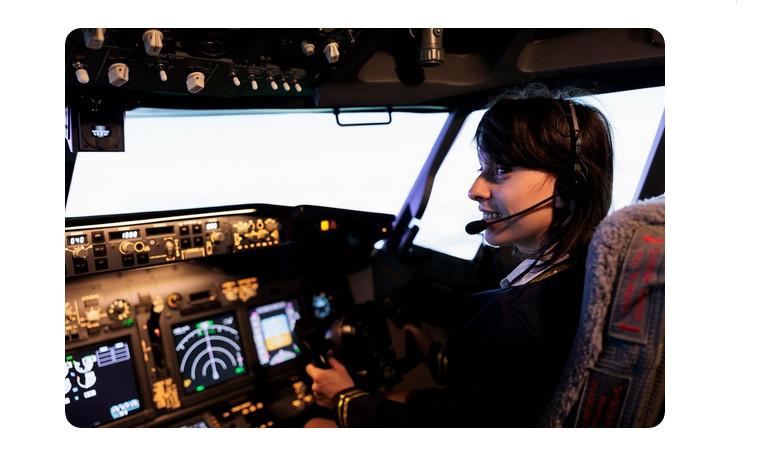
Everyone has witnessed the recent events unfolding in the aviation sector: pilot shortages, long queues at airports, flight cancellations, frustrated passengers, allegations of monopolistic practices, and the subsequent clarifications issued by the airlines.
However, our discussion today will not focus on these issues, but rather on the employment opportunities within the sector.
In India, the aviation sector is a rapidly growing force within the economy. Its contribution of over US$ 53.6 million to the Indian economy—along with providing employment to more than 7.5 million people—stands as clear evidence of this fact.
In 2024 alone, the Directorate General of Civil Aviation (DGCA) issued over 1,300 Commercial Pilot Licenses, signifying that an equal number of new pilots have joined the workforce this year.
In this episode of ‘Career Connect,’ we will discuss a profession that is often dreamed of while standing on the ground, but which ultimately finds its fulfillment amidst the heights of the sky—the profession of becoming a pilot.
How does an individual navigate this journey to the cockpit?
The first question that naturally comes to mind is this: How does one actually become a pilot? A pilot associated with a prominent airline provided us with the answer.
He explained that there are two primary pathways to becoming a pilot in India: one is the traditional route, which has been in existence for many years, and the other involves enrolling in a cadet pilot program offered by an airline company.
In both instances, the applicant must be at least 18 years of age. Furthermore, it is mandatory to secure a minimum of 50% marks in the Class 12 examinations, specifically in the subjects of Physics and Mathematics.
For individuals with a Commerce or Arts background, it is mandatory to pass the Class 12 examinations in Physics and Mathematics through the National Institute of Open Schooling (NIOS) or via the open examination system of any State Board. The Directorate General of Civil Aviation (DGCA) is the regulatory body governing aviation in India. The DGCA has authorized numerous doctors across the country to conduct the medical examinations required for pilot training.
Before commencing pilot training, a student is required to possess a ‘Class 2 Medical Certificate.’ These certificates are issued by doctors specifically approved by the DGCA, who determine whether an individual is medically fit to undergo training.
Subsequently, a Class 1 Medical Examination is conducted; this examination is administered by the DGCA and performed by doctors approved by the Indian Air Force.
The certificate obtained from this examination is mandatory for acquiring a Commercial Pilot License (CPL). The examination includes eye tests, an ECG, blood tests, and an examination of the nose, ears, and throat.
The total cost for both examinations amounts to approximately ₹10,000.
However, an individual suffering from color blindness cannot become a pilot. Furthermore, certain basic tests—such as blood and urine analyses—are conducted initially; if a candidate fails even one of these tests, they cannot proceed to become a pilot.
What happens next?
To obtain a pilot license, it is mandatory to complete 200 hours of flight training.
After fulfilling all eligibility requirements, candidates must appear for the DGCA’s CPL examination. This examination is typically conducted four times a year.
For those who pass this examination, the training is divided into two phases: Ground Training and Flight Training.
Ground Training constitutes the academic phase of pilot training. It covers subjects such as Meteorology, Air Regulations, Navigation, Radio Telephony, and Technical Studies.
Candidates are required to secure a minimum score of 70% in the written examinations for these subjects. Subsequently, candidates enroll in various DGCA-approved Flying Training Organizations (FTOs) across India, where they acquire 200 hours of flight experience.
Alternatively, a second pathway available is the Cadet Pilot Program, which is conducted directly by airline companies.
According to experts, if a candidate chooses to launch their aviation career through an airline’s Cadet Pilot Program, they follow a structured curriculum that encompasses both theoretical and practical training.
This program provides in-depth instruction on the fundamentals of aviation. Additionally, practical flying sessions are conducted at partner Flying Training Organizations (FTOs).
This integrated training curriculum is designed to ensure that pilots acquire skills that align precisely with the specific requirements of the aviation industry.
For instance, Air India offers a Cadet Pilot Program. Under this initiative, candidates receive training for a Commercial Pilot License (CPL) and a Type Rating—conducted jointly at the Air India Flying Training Academy and at two of the airline’s global partner schools.
During the flight training phase, candidates are taught to fly smaller aircraft.
However, when they are ready to fly actual passenger aircraft, they require an additional license; this is known as a Type Rating.
Air India’s training academy is located in Amravati, Maharashtra, while its two global partner schools are situated in the United States.
Through these Cadet Programs, airline companies themselves select students as cadets—typically following the completion of their 12th-grade education—based on their performance in a series of selection tests.
These selected candidates then undergo flight training, and upon their return to the airline, they receive their Type Rating. However, the fees associated with this program tend to be higher.
Flight Training: What is the Cost?
Training to become a pilot can be undertaken in any country.
Passing the written examinations typically takes at least six months, after which the actual flight training phase begins.
In this process, candidates select the country where they wish to undergo this training. This training can be pursued either in India or in another country.
Captain Mohit, who went viral for his poetic in-flight announcements, now runs a training academy named ‘Poetic Pilot’ while simultaneously working as an instructor for an airline company.
He states, “Most people opt for India, the USA, or South Africa, while some—like myself—prefer to go to Canada. It makes no difference where you undertake your flight training, as ultimately, you are required to pass the DGCA written examination regardless. Furthermore, airline companies do not accord any special preference to training obtained from a specific country. The crucial factor is whether or not you possess an Indian pilot’s license.”
In India, completing this training at a reputable academy takes 14 to 15 months, and the cost amounts to approximately ₹50–55 lakhs.
In the USA, this training can be completed within 10 months, and the cost remains roughly the same—approximately ₹50–52 lakhs.
In South Africa, it is a 12-to-14-month course, with costs ranging between ₹35 lakhs and ₹40 lakhs.
Captain Mohit explains, “This is unlike a standard university degree program, where the course duration is fixed at three or four years for every student. Instead, the requirement here is that the candidate must complete 200 hours of flight training—that is, actual hands-on experience in the cockpit. Some individuals manage to complete this in just ten months, while others may take longer.”
Upon completing the training, candidates become eligible to apply for and work as pilots at any airline company that is actively recruiting at that time. According to Captain Mohit, when a pilot joins an airline, their initial designation is that of a ‘First Officer.’ In this role, they work alongside the Captain as a co-pilot.
To become a Captain, a distinct license is required—known as the ATPL, or Airline Transport Pilot License.
To obtain this license, candidates must successfully pass the DGCA examinations. These courses typically cover subjects such as navigation, radio navigation, and meteorology. However, it is mandatory for candidates to possess a minimum of 1,500 hours of flight experience. As soon as a vacancy arises, one should apply immediately; subsequently, the respective airline conducts a written examination. These examinations differ from the DGCA exams and are entirely merit-based.
Captain Mohit explains, “Think of it this way: if an airline requires 300 pilots and 1,000 candidates appear for the exam, the company will invite only the top scorers to the next round. Conversely, while a minimum score of 70 marks is required to pass the DGCA examination, scoring 80 or 90 marks does not confer any special privilege or advantage upon the candidate.”
What about Salary and Career Growth?
In India, the monthly salary of a Flight Captain can range between ₹4 lakhs and ₹8 lakhs.
A pilot informed us that salaries within India’s aviation industry are quite attractive.
Furthermore, the DGCA has now established regulations designed to assist pilots in maintaining a healthy work-life balance. According to Captain Mohit, “A mandatory rest period of 12 hours is prescribed for a pilot. When the commute time to and from the airport is factored in, this effectively translates into a break of approximately 15 hours. Furthermore, it is mandatory for a pilot to take a continuous break of 48 hours—that is, two full days—once every week. Previously, this mandatory rest period was 36 hours.”
In terms of salary, a First Officer typically earns between ₹1.25 lakh and ₹2.5 lakh per month.
In contrast, for someone holding the rank of Captain, this figure rises to between ₹4 lakh and ₹8 lakh per month. Moreover, if one works for an international airline, the salary can exceed even these figures.
Captain Mohit explains that there are often more vacancies for pilots in Middle Eastern countries; the primary reason for this is that very few local citizens in those regions choose to pursue this profession. There, a First Officer can earn up to ₹8–9 lakh per month, and the tax burden is also lower. However, this requires you to reside in a foreign country—which implies that your cost of living will also be higher.
According to Captain Mohit, a pilot’s role is not limited solely to flying aircraft. Instead, they can work as instructors at an airline academy,
serve as flight dispatchers, or even become pilots for chartered aircraft.
Just as there are countless benefits to becoming a pilot, the associated education and training are equally expensive. The cost of a standard CPL (Commercial Pilot License) training course typically ranges from ₹55 lakh to ₹85 lakh.
Meanwhile, some airlines may charge ₹1 crore or even more for their cadet pilot training programs. We asked Captain Rahul how a student from an ordinary family could possibly arrange such a large sum of money. Drawing upon his own experience, he explained: “An education loan is an excellent solution for this. This is because, if you have.









Leave a Reply