

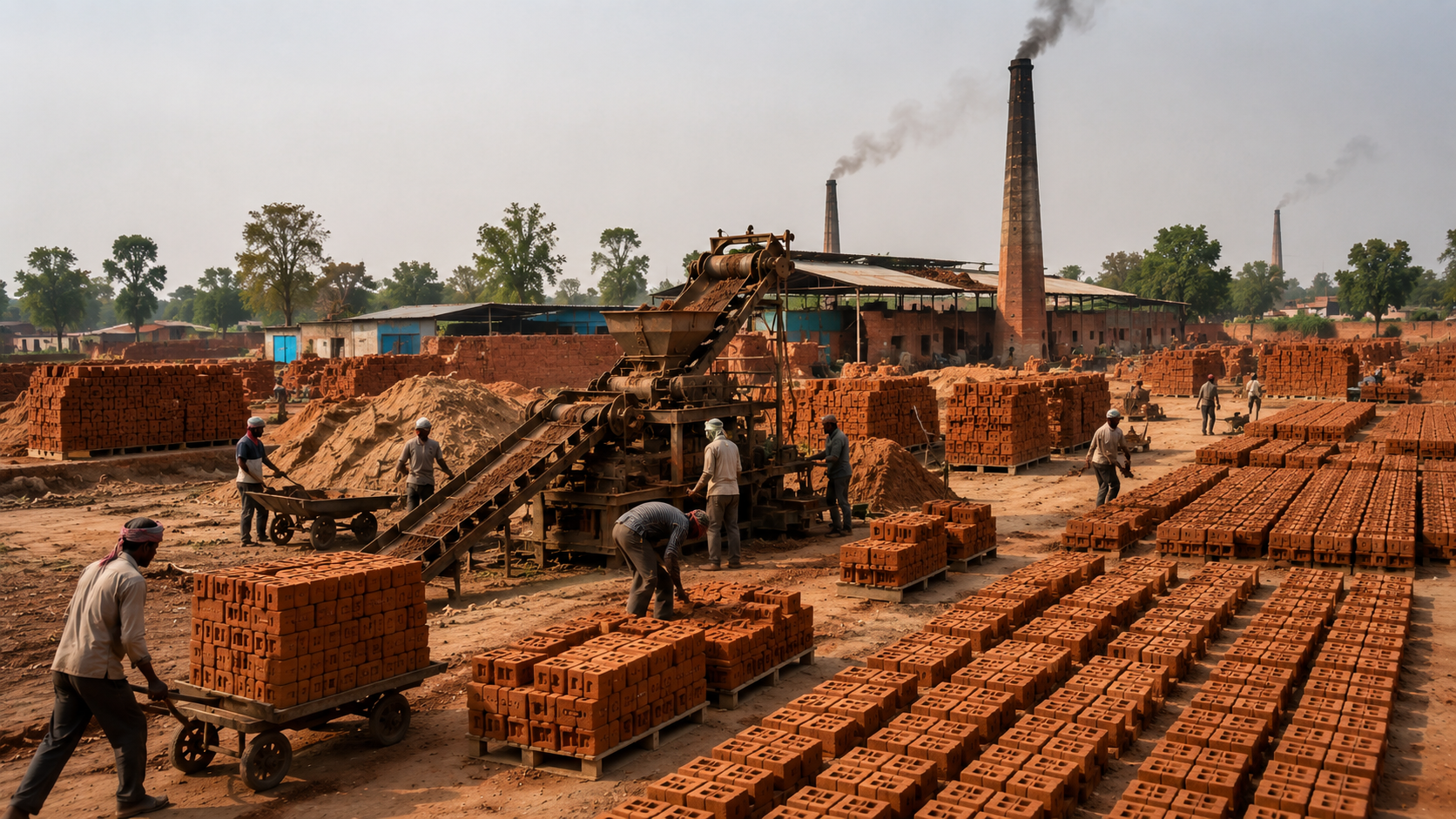
Walk into any brick factory built in the last decade, and you’ll forget everything you thought you knew about brick-making. Gone are the days of barefoot workers slapping mud into wooden moulds under the open sun. Today’s brick factories look more like food processing plants — clean, automated, and surprisingly quiet.
I want to show you what actually happens behind the gates of a serious brick factory india has to offer. The process is more fascinating than most people realise.
Step 1: It All Starts With the Right Clay
Not all soil makes good bricks. The clay needs the right mix of silica, alumina, and iron oxide. Too much sand, and your brick crumbles. Too much lime, and it cracks during firing. At Mahaluxmi Bricks, we source clay from specific deposits across north India where the soil chemistry is naturally balanced.
Trucks dump fresh clay into outdoor stockyards where it sits for weeks. This ‘weathering’ period sounds boring, but it matters — rain, sun, and air break down the clay particles and remove impurities. Old-school brick factories skip this step. Modern ones never do.
Step 2: Mixing and Conditioning
The aged clay then enters a pug mill — basically a giant industrial mixer that grinds the clay with water and additives. The clay comes out the other end as a thick, smooth paste with the consistency of stiff cookie dough.
This step decides whether your brick making plant produces strong bricks or weak ones. Get the water content wrong by even 2%, and the whole batch suffers.
Step 3: Shaping the Bricks
Here’s where machines do what hands used to do. A vacuum extruder pushes the clay through a die shaped exactly like a brick cross-section. The result is a long clay ‘log’ that gets cut into individual bricks by wire blades, like slicing a loaf of bread.
Each cut brick goes onto a moving belt. A modern brick factory can shape up to 30,000 bricks per hour this way. That’s roughly one brick every tenth of a second.
Step 4: Drying — The Patient Stage
Wet bricks can’t go straight into the kiln. Trapped water turns to steam during firing, and steam wants to escape — violently. So we dry the bricks first.
In our brick making plant, drying chambers use waste heat from the kilns to gently remove moisture over 24-48 hours. The bricks lose around 12-15% of their weight as water evaporates. By the end, they’re hard but pale — ready for fire.
Step 5: Firing in the Kiln
This is the magic moment. The dried bricks enter a tunnel kiln where temperatures climb to 1000°C and stay there for 18-24 hours. The clay particles fuse together at this heat, creating a stone-hard structure that water and weather can’t break down.
You can tell a well-fired brick from a poorly-fired one just by colour. Properly fired bricks have a deep, even red.
Underfired bricks look pale and dusty. Overfired ones look glassy and dark. Our quality team rejects anything that doesn’t match the target shade.
Step 6: Cooling and Sorting
After firing, bricks slowly cool down over another 8-10 hours. Rushing this step causes hairline cracks that show up later as wall problems. Patience pays off.
Once cooled, bricks pass through a sorting line. Workers and machines check each piece for cracks and chips, correct dimensions, colour consistency, and sharp edges. Anything below standard gets rejected. We don’t ship seconds as firsts — and that’s a habit not every brick factory keeps.
What Sets a Good Brick Factory in India Apart
You can find hundreds of brick factories across India, but only a small percentage run modern operations. The good ones share a few traits — tunnel kilns instead of old Bull’s Trench Kilns, automated forming and cutting lines, lab testing for every batch, pollution control equipment, and trained workers, not casual labour.
When you visit a brick factory india-based and you see white smoke and quiet machines, you’re at a serious plant. If you see kids carrying clay and thick black smoke pouring out, walk away.
Why Mahaluxmi’s
Brick Making Plant Stands Out
We invested heavily in the past few years to upgrade every part of our brick making plant. We measure quality at every stage — not just at the end. Our reject rate sits below 3%, which beats the industry average of 8-12%.
We also care about the environment. Our kilns use cleaner fuel, recycle heat, and emit a fraction of what older brick factories release. You get strong bricks without sponsoring pollution.
See It For Yourself
We welcome customers to visit our plant. Seeing where your bricks come from changes how you think about them. Book a visit through our website, and we’ll walk you through every step personally.






Leave a Reply