 Sweta
Sweta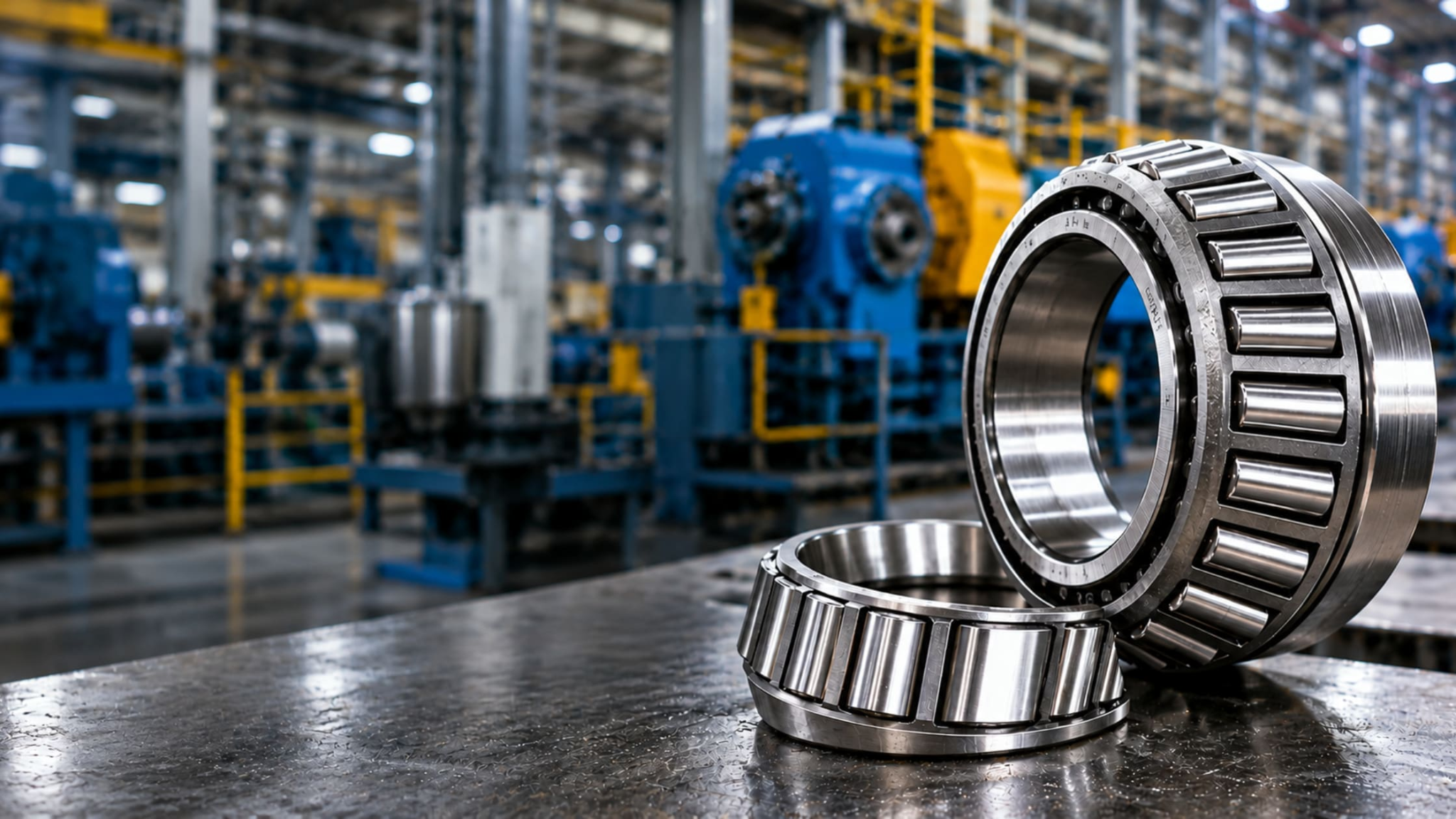
Introduction
Industrial growth does not announce itself through machinery that fails. It runs on components nobody notices — shafts turning at 3,000 rpm under radial and axial load simultaneously, wheel hubs absorbing road shock across 500,000 kilometers of service life, gearbox input shafts transmitting 1,200 Nm of torque through a contact zone smaller than a thumbnail. The bearing inside each of those assemblies is not incidental to the machine’s output. It is the mechanism by which the machine’s output becomes possible.
Taper roller bearing manufacturers India have positioned themselves inside that equation at a scale that global procurement teams are no longer able to overlook. The synergy of advanced metallurgy knowledge, high-level precision machining capabilities, competitive pricing, and quality certifications has made Indian taper roller bearings a truly international product line, supplying automotive, mining, wind power, and heavy industry OEMs simultaneously across North America, Europe, the Middle East, and Southeast Asia.
What it takes to get there cannot be understood through merely analyzing the prices, but has deeper roots in engineering and process excellence.
The Geometry That Makes Taper Roller Bearings Irreplaceable
Not every bearing handles combined loading. Deep groove ball bearings carry radial load efficiently but deflect under sustained axial thrust. Cylindrical roller bearings carry very high radial loads but require a separate thrust bearing in the assembly when axial forces are significant. The taper roller bearing solves both problems in one unit by exploiting a geometric relationship that the industry has relied on since 1898 — the apex of the cone formed by the inner race, outer race, and roller axis converges at a single point on the bearing’s rotational axis, which is what allows the bearing to carry radial and axial loads simultaneously without generating parasitic sliding friction at the roller-race contact.
The contact angle — defined as the angle between the bearing axis and the line connecting the contact points on inner and outer raceway — determines the load ratio the bearing handles. Shallow contact angles of 10–16° favour radial load capacity and are used in automotive wheel hubs and transmission shafts where radial forces dominate. Steep contact angles of 25–30° shift capacity toward thrust load and appear in bevel gearbox arrangements and screw conveyor drives where axial forces are the primary design concern. Taper roller bearing manufacturers India producing across this full contact angle range — from single-row configurations in the 15° range through double-row and four-row arrangements for rolling mill and heavy vehicle axle applications — are supporting design requirements that vary enormously across the industrial sectors they serve.
Raw Material and Steel Quality: Where Bearing Life Is Decided
A taper roller bearing’s contact stress at the roller-race interface under full rated load reaches 2,000–3,500 MPa — a number that sits at the upper boundary of what engineered steel can sustain on a cyclic basis without subsurface fatigue crack initiation. At that stress level, the steel’s cleanliness — the absence of non-metallic inclusions, oxide stringers, and carbide segregation bands — is not a secondary quality parameter. It is the primary determinant of rolling contact fatigue life.
Bearing-quality steel to IS 6770 or its international equivalents (SAE 52100, DIN 100Cr6) specifies not just chemistry but inclusion rating per ASTM E45 or SEP 1571 — with acceptable limits for oxide, sulphide, silicate, and globular inclusion types measured against reference charts at 100x magnification on polished and etched cross-sections. Sulphur content below 0.025% and phosphorus below 0.025% are standard minimum requirements, but first-tier bearing manufacturers push steel specifications to sulphur below 0.015% and oxygen content below 10 ppm through vacuum degassing during steelmaking to achieve inclusion levels in the A1–B1 range on the ASTM scale.
Taper roller bearing manufacturers India sourcing from integrated steel suppliers with vacuum induction melting and vacuum arc remelting capability — available through domestic producers at facilities in Gujarat, Maharashtra, and Jharkhand — operate with incoming material verification by optical emission spectrometry on every heat and ultrasonic testing on bar stock above 40 mm diameter to detect sub-surface seams and pipe defects before the first turning pass. That incoming material discipline is not optional at this contact stress level. It is the baseline.
Heat Treatment: The Controlled Science Behind Surface Hardness
The roller and inner ring of a taper roller bearing run at 58–65 HRC surface hardness — hard enough to resist plastic deformation at the contact ellipse under peak load, tough enough to resist fracture under shock loading in mining equipment or off-highway vehicle axles. Achieving that combination on a through-hardened 100Cr6 ring requires an austenitizing cycle at 820–850°C with soak time calculated per cross-sectional thickness, followed by oil or press quenching to control distortion, and tempering at 150–180°C to relieve quench stress while retaining hardness in the 60–64 HRC range.
Retained austenite — the fraction of austenite that does not transform to martensite during quenching — must be held below 8–12% by volume in finished bearing rings. Excess retained austenite transforms progressively under cyclic contact stress in service, producing dimensional instability that manifests as bearing preload loss in precision spindle applications or increased clearance in automotive wheel hub assemblies. Cryogenic treatment at -80°C to -120°C between quench and temper drives retained austenite below 4–6%, an additional step that taper roller bearing manufacturers India supplying to machine tool spindle and aerospace-adjacent applications incorporate as a standard process stage rather than an optional upgrade.
Case-carburized variants for applications requiring core toughness alongside surface hardness — shock-loaded mining sheave shafts, for example — use 20MnCr5 or 18NiCrMo5 grades, carburized to 0.8–1.2 mm effective case depth, achieving identical surface hardness over a core at 35–45 HRC that absorbs impact energy the through-hardened variant cannot.
Dimensional Accuracy and the Tolerances That Define Bearing Grade
Bearing bore, outside diameter, and width tolerances are defined in ISO 492 and ABEC (ANSI/ABMA) grade standards. A standard ABEC 1 (Normal) taper roller bearing in the 30000 series with 50 mm bore carries bore tolerance of 0 / -0.012 mm and outside diameter tolerance of 0 / -0.015 mm. ABEC 3 (P6) tightens those to 0 / -0.010 mm and 0 / -0.011 mm respectively, while ABEC 5 (P5) demands 0 / -0.008 mm on bore and 0 / -0.009 mm on outside diameter — tolerances that require CNC grinding with in-process gauging feedback and thermal compensation for workpiece and machine temperature variation during the grinding cycle.
Roller geometry tolerances in precision-grade bearings specify diameter variation within a single roller below 1.5 µm and mean diameter variation across the complement below 2.5 µm. These are not specification numbers that conventional cylindrical grinding achieves without process engineering. Centreless grinding with CBN wheels, closed-loop diameter feedback, and coolant temperature control at ±1°C maintains roller diameter scatter in the 0.5–1.0 µm range on production runs — the level required for P5 and P4 grade bearings where roller size variation directly contributes to running noise and vibration at the NRRO (non-repetitive run-out) level.
Taper roller bearing manufacturers India certified to IATF 16949:2016 measure Cpk values on bore, OD, and roller diameter as PPAP gate requirements, with minimum Cpk 1.67 on critical dimensions for automotive OEM supply — a statistical capability threshold that, at process sigma level, equates to fewer than 6 defective parts per billion opportunities.
Cage Design and Material: The Component That Controls Roller Dynamics
The cage in a taper roller bearing does not carry load. It spaces rollers, maintains the complement’s angular distribution, and guides the roller set during acceleration and coast-down when the bearing operates under light or zero load — the condition where roller skewing and smearing damage initiate if the cage geometry is inadequate.
Pressed steel cages, formed from 1–2 mm low-carbon sheet and riveted or clinched, serve the majority of industrial and automotive taper roller bearing applications at cost. Machined brass cages — turned from CuZn40Pb2 or similar free-machining brass to pocket tolerances of ±0.05 mm — appear in high-speed applications above dn values of 400,000 mm·rpm, where cage mass and centrifugal loading become factors, and in applications where the lubricant is incompatible with steel cage corrosion products. Glass-fibre reinforced polyamide cages, injection-moulded to pocket geometries controlled within ±0.03 mm, cover medium-speed applications in contaminated environments where cage corrosion from water ingress would compromise pressed steel integrity.
The cage selection decision changes the bearing’s speed rating, load rating under oscillatory motion, and lubrication requirement — and it is a decision that taper roller bearing manufacturers India supplying across mining, wind turbine pitch and yaw systems, and automotive drivetrains are making application-specifically rather than defaulting to a single cage type across all products.
Export Capability and Global Quality Alignment
India’s taper roller bearing exports have grown consistently through the 2010s and into the 2020s, with bearing exports from India reaching approximately USD 800 million annually by the early 2020s and continuing to expand. The destination markets are not low-specification or price-only procurement environments. German industrial machine OEMs, US agricultural equipment makers, and Japanese automotive Tier 1 suppliers maintain the exact incoming inspection criteria for bearings made in India as they do for bearings of other geographies – and taper roller bearing manufacturers India supplying those markets have established the quality structure required to be able to deliver that criterion repeatedly.
Quality system certifications including ISO/TS 16949 and IATF 16949:2016, ISO 9001:2015 QMS, ISO 14001:2015 EMS, and frequently OHSAS 18001 / ISO 45001 OH&S certification constitute the documented Quality System level. Certificates of hardness per ASTM E18 on each production batch, dimension sheets per ISO 492, vibration tests per ISO 15242 (based on vibration velocity values measured in mm/s RMS at low, middle, and high frequencies), and noise measurements by means of the Anderometer scale make up the level of proof of the particular product that buyers’ engineering departments and incoming inspectors expect in order to certify a new bearings supplier.
The capability to provide full PPAP Level 3 documentation — including design and process FMEAs, control plans, process capability studies, GR&R results on critical gauging, and initial sample inspection reports with full dimensional layout — separates manufacturers operating at global tier-1 supply standard from those operating at catalogue distributor level.
Supporting Sectors That Drive Industrial Growth
The industrial growth that taper roller bearing manufacturers India support is not abstract. It is specific — and the specificity matters because each application sector imposes different performance requirements that the same bearing geometry must satisfy through different material and process choices.
In wind energy, main shaft bearings in 2–5 MW turbines carry combined radial and bi-directional axial loads for a 20-year design life with L10 life requirements calculated at 175,000 hours — a fatigue life target that demands not only premium steel cleanliness but full documentary traceability from steel heat number through forge lot, heat treatment batch, and grinding batch to finished bearing serial number. In mining, four-row taper roller bearings in rolling mill pinion stands and crusher shaft assemblies operate under shock loads of 3–5x rated static capacity with grease relubrication intervals measured in weeks rather than months, placing maximum demand on cage robustness and internal geometry precision to maintain roller alignment under dynamic overload. In automobiles, wheel hub bearing assemblies using taper roller configurations support both radial loads caused by the weight of the vehicle as well as axial loads generated due to cornering loads, the sealings ensuring that the lubrication is retained and contaminants are prevented over temperature ranges from -40°C to +120°C throughout a lifespan of 250,000 km and beyond.
The wind power generation industry is expanding, as is the mining industry for copper, lithium, and iron ore; likewise, the automobile sector in India as well as its exports; and with them, the need for taper roller bearings is increasing too.
Conclusion
Industrial growth runs through the components nobody thinks about until they fail. Taper roller bearings are among the least celebrated and most consequential of those components — tolerating contact stresses that push engineering steel to its limits, maintaining dimensional accuracy across thousands of production hours, and performing in environments ranging from Antarctic wind turbines to tropical mining operations without adjustment or intervention.
Taper roller bearing manufacturers India are not participating in global industrial growth as a secondary supply option. They are embedded in it — through certified quality systems, verified material and process controls, and dimensional capability that meets the same standards applied to bearing production anywhere in the world. The growth story is already happening. The engineering foundation that makes it credible has been built one controlled process at a time.